
Hot Air Ovens are one of the most essential instruments in any lab used daily for sterilization, drying, heating, curing, and material testing. But between choosing the right capacity, understanding compliance requirements, and knowing what NOT to put inside one, there’s a lot buyers wish someone had explained upfront.
This week, we’re answering the questions we get asked most.
What is a Hot Air Oven?
A laboratory instrument that sterilizes and dries materials using dry heated air no steam, no moisture. Electric heaters warm the chamber while a fan circulates hot air uniformly throughout, giving consistent temperature distribution across every shelf.
Is a Hot Air Oven the same as an Autoclave?
No. Autoclaves sterilize using steam under pressure. Hot Air Ovens use dry heated air -better suited for materials that shouldn’t get wet, like glassware and metal instruments. Dry heat also destroys microorganisms through oxidation, versus the moist-heat process autoclaves rely on.
Which industries actually use these?
Pharmaceutical, biotechnology, food testing, chemical, medical, hospitals, universities, research institutes, environmental labs, and QA/QC facilities essentially anywhere sterilization, drying, or controlled heating is part of the daily workflow.
What Can (and Can’t) Go Inside
What can be sterilized or dried?
Glassware, petri dishes, pipettes, metal instruments, surgical tools, powders, oils, and general lab accessories.
What should never go inside?
Plastic, rubber, culture media, living organisms, flammable chemicals, and volatile solvents. These either can’t withstand dry heat or pose a safety risk.
Temperature & Performance
What temperature range should I expect?
Typically ambient +5°C to 250°C enough range to cover most sterilization, drying, and curing applications.
Why does temperature uniformity matter so much?
Uneven heating inside the chamber can compromise sterilization results or affect sample integrity even if the display shows the “right” number. This is different from temperature accuracy, which is simply how close the displayed reading is to the actual chamber temperature. A well-designed oven gets both right.
Does opening the door mid-cycle cause problems?
Yes heat escapes every time, and how fast the oven recovers depends on its design and air circulation system. This is worth asking about directly if your workflow involves frequent door access.
Why is forced air circulation better than natural convection?
It heats faster and distributes temperature far more evenly across the chamber which is why it’s the standard on higher-end lab ovens.
Compliance & Data
What does 21 CFR Part 11 compliance actually mean?
It enables secure electronic records and electronic signatures a requirement for regulated industries like pharma, where every temperature log may need to hold up during an audit.
Is an audit trail available?
Yes, on advanced lab-grade models, along with data logging that records operating temperatures over time for QA documentation.
What happens during a power failure?
On advanced models, settings and program progress are retained, and the oven resumes once power returns so you don’t lose a run partway through.
Build & Construction
Why do most quality ovens use SS304 stainless steel?
It’s corrosion-resistant, easy to clean, and hygienic. Important for chambers exposed to repeated heating cycles and lab environments.
Why do door gaskets matter?
They minimize heat loss and keep internal temperature stable a small detail that has a real impact on energy efficiency and consistency.
If you’re comparing hot air ovens, the questions worth asking go beyond the price tag:
- Chamber capacity – matched to your sample volume and daily throughput
- Temperature range and uniformity – not just the number on the spec sheet
- Controller type – PLC controllers (touchscreen, data logging, connectivity) vs. simpler PID controllers for standard heating
- Data logging and compliance – do you need 21 CFR Part 11, or just basic logging?
- Safety features – over-temperature protection, alarms, sensor monitoring
- Certifications and documentation — IQ/OQ support, calibration services, and compliance compatibility
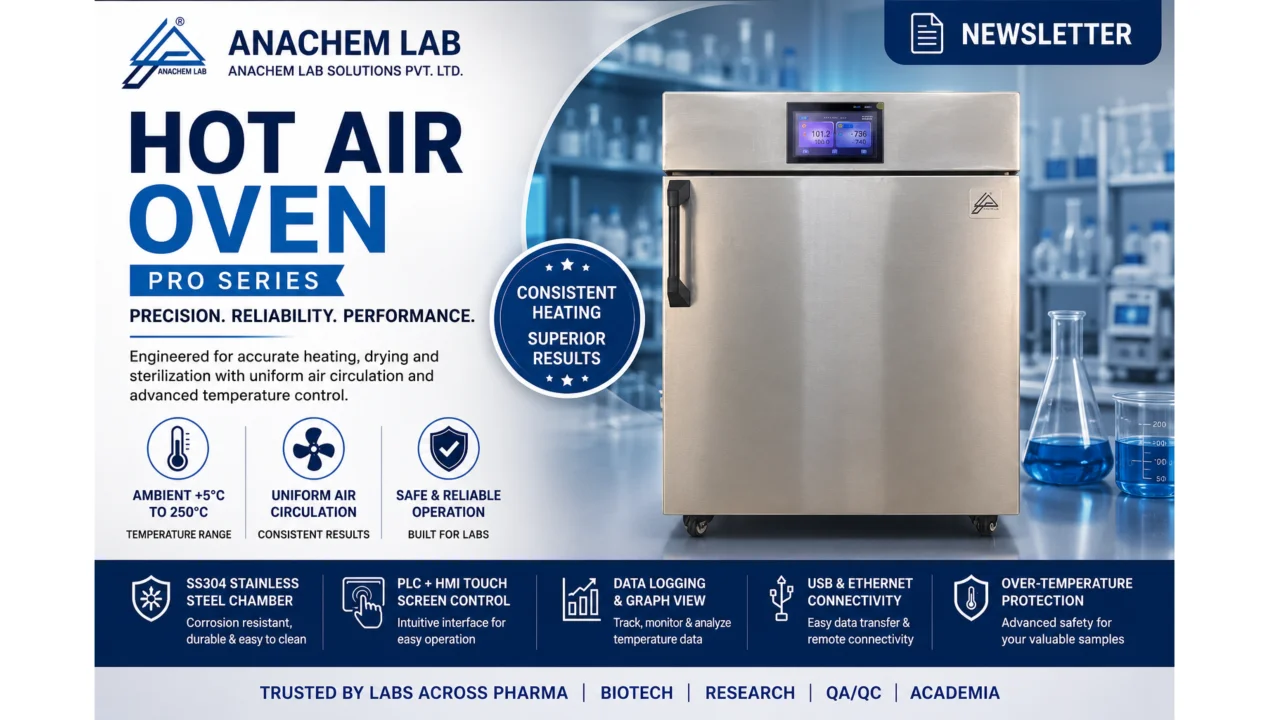
Why Labs Choose the Anachem Lab Hot Air Oven Pro Series
- PLC + HMI touchscreen control
- Forced air circulation for uniform heating
- SS304 stainless steel chamber
- Temperature range: Ambient +5°C to 250°C
- USB & Ethernet connectivity
- Built-in data logging
- Multiple capacity options (90L to 400L, up to 1000L on request)
- Advanced safety features, including DIN 12880 over-temperature protection
- Optional 21 CFR Part 11 compliance
- Designed for pharmaceutical, research, biotechnology, and QA/QC laboratories
We also support installation, calibration, and after-sales service – because choosing the right oven is only half the job; keeping it running accurately is the other half.
👉 Explore the Hot Air Oven Pro Series

Author: anachem_newuser
Anachem Lab Solutions Pvt. Ltd. is an ISO 9001-certified manufacturer of laboratory instruments including hot air ovens, stability chambers, incubators, ice flake machines, and vacuum ovens. Recognized under Make in India, with CE certification and presence on the GeM portal, we deliver reliable, high-quality solutions to research labs, pharma, hospitals, and industries.