
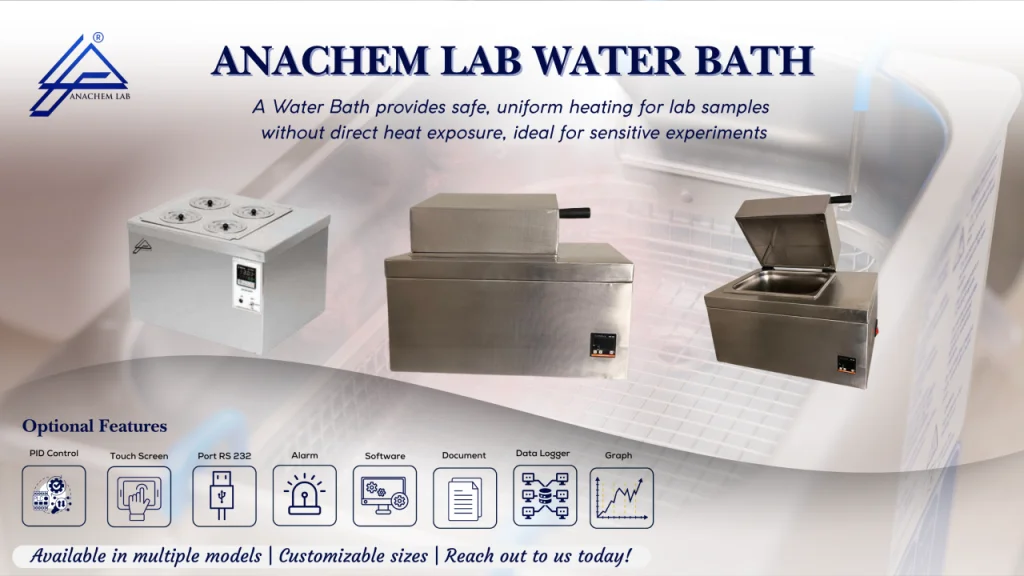
A laboratory water bath is one of the most essential heating devices used in research, diagnostics, and industrial testing. It provides uniform heating at controlled temperatures, making it ideal for experiments that require gentle and consistent heat without direct flame exposure. From microbiology to pharmaceuticals, the water bath applications in laboratory work ensure accuracy, safety, and reliability.
What is a Laboratory Water Bath?
A water bath in laboratory is a container filled with heated water, used to incubate or heat samples at a constant temperature. It consists of a stainless-steel chamber, a thermostat, a heating element, and a digital or analog controller.
Types of Water Baths in Laboratory
General-purpose water baths – Used for standard heating tasks
Circulating water baths – Maintain uniform temperature throughout the chamber
Shaking water baths – Provide mixing and heating simultaneously
Refrigerated water baths – Offer cooling below ambient temperatures
At Anachem Lab Solutions Pvt. Ltd., we manufacture digital water baths engineered with precision, safety, and durability for advanced laboratory needs.
Working Principle of Water Bath
The principle of water bath in laboratory is based on indirect heating. A thermostatically controlled heating element raises the water temperature to the set value. The thermostat then ensures stable and accurate temperature regulation, allowing test tubes, flasks, and samples to be heated gently and uniformly.
Key Features and Specifications of Laboratory Water Bath
When choosing a laboratory water bath, look for these important features:
Temperature Range: Ambient +5°C to 100°C
Accuracy & Uniformity: ±0.1°C to ±1°C
Digital Control: Advanced PID controller for precise regulation
Material Construction: Inner chamber made of SS-304 or SS-316 stainless steel for durability and corrosion resistance
Safety Mechanisms: Over-temperature protection & low water level cut-off
Lid/Cover: Reduces evaporation and conserves energy
Optional Accessories: Racks, shaking platforms, and gable covers
Water Bath Applications in Laboratory
Water baths are widely used across multiple industries and research areas. Below are the major applications:
Applications of Water Bath in Microbiology
Used for incubating cultures, maintaining microbial growth, and conducting enzyme reactions under constant temperatures.
Applications of Water Bath in Chemistry
Essential for warming reagents, dissolving compounds, melting substances, and maintaining controlled reaction conditions.
Applications of Water Bath in Biotechnology
Supports DNA amplification, protein studies, enzyme reactions, and other sensitive molecular biology experiments.
Applications of Water Bath in Pharmaceuticals
Helps in stability testing, drug solubility studies, and sample preparation under consistent thermal conditions.
Applications of Water Bath in Clinical Diagnostics
Used for thawing frozen samples, warming IV fluids, and maintaining blood samples at required temperatures.
These broad water bath applications in laboratory work highlight its importance across scientific disciplines.
(H2) Advantages of Using a Laboratory Water Bath
Provides uniform heating without hot spots
Safe for flammable chemicals (no open flame)
Accurate and repeatable temperature control
Easy to operate, clean, and maintain
Versatile with multiple configurations (circulating, shaking, refrigerated, digital)
Types of Laboratory Water Baths
Circulating Water Bath – Best for consistent temperature distribution
Shaking Water Bath – Combines mixing with heating
Refrigerated Water Bath – Maintains low or sub-ambient temperatures
Digital Water Bath – Offers programmable and highly precise control
Maintenance Tips for Long-Lasting Performance
Use distilled or deionized water to prevent mineral deposits
Clean regularly to avoid microbial contamination
Calibrate temperature controllers periodically
Never operate with low water levels
Frequently Asked Questions (FAQ)
What is the principle of water bath in laboratory?
The water bath works on the principle of indirect heating, where an electric element heats the water and the immersion warms the samples uniformly.
What are the applications of water bath in microbiology?
Researchers use them for incubation, enzyme reactions, and microbial growth studies at constant temperatures.
Why is a water bath important in chemistry labs?
Chemistry lab’s water baths is important Because it provides safe and uniform heating for reagents and reactions without the risk of open flames.
What is the temperature range of a laboratory water bath?
Most models operate between ambient +5°C and 100°C with accuracy ranging from ±0.1°C to ±1°C.
How do you maintain a laboratory water bath?
Use distilled water, clean regularly, calibrate controllers, and avoid running with low water levels.
Is a water bath also used in the food industry?
Yes, the food industry uses water baths for applications such as pasteurization, quality testing, and maintaining precise temperatures during product development. Their ability to provide uniform and controlled heating makes them valuable in both research labs and industrial food processing

Need further assistance?
Need help finding the answers you need? Let’s have a conversation.
The applications of water bath in laboratory environments make it an indispensable tool for modern science. By providing stable, safe, and precise heating, water baths support a wide range of experiments in microbiology, chemistry, biotechnology, pharmaceuticals, and clinical diagnostics.
At Anachem Lab Solutions Pvt. Ltd., we offer high-performance digital water baths built for accuracy, durability, and safety. Whether you need a circulating water bath, shaking water bath, or refrigerated model, our experts can guide you in choosing the best solution.
📞 Contact us today to explore our advanced range of laboratory water baths.

Author: anachem_newuser
Anachem Lab Solutions Pvt. Ltd. is an ISO 9001-certified manufacturer of laboratory instruments including hot air ovens, stability chambers, incubators, ice flake machines, and vacuum ovens. Recognized under Make in India, with CE certification and presence on the GeM portal, we deliver reliable, high-quality solutions to research labs, pharma, hospitals, and industries.

