
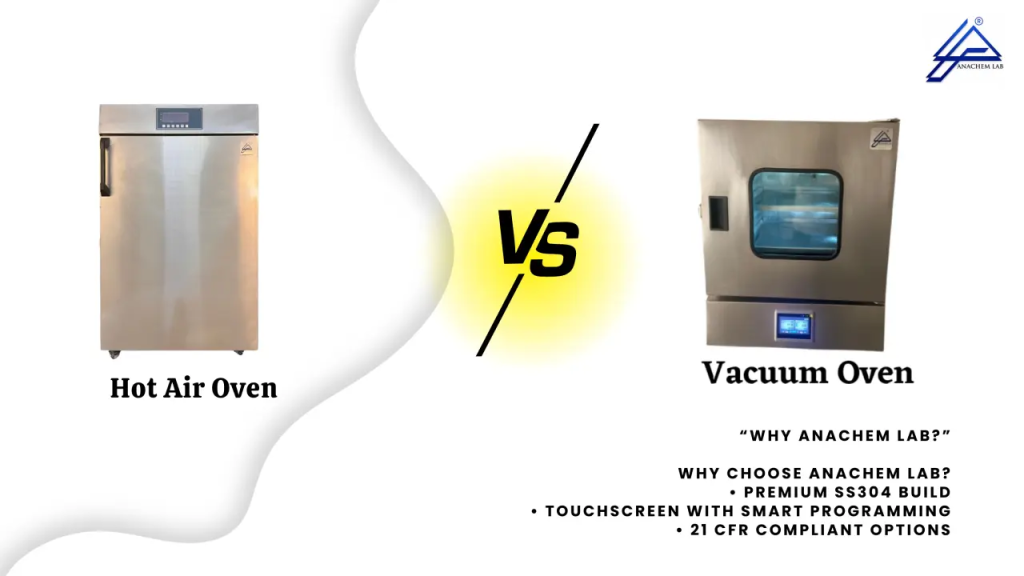
In modern laboratories and industrial research, ovens play a vital role in processes such as sterilization, drying, and heat treatment. The two most commonly used types are Hot Air Ovens and Vacuum Ovens.
Both are essential, but they serve different purposes. Choosing the right one can save time, ensure accuracy, and protect sensitive materials.
At Anachem Lab Solutions Pvt. Ltd., we design and manufacture precision-engineered ovens for pharmaceutical, biotech, R&D, and quality control laboratories. Let’s explore the difference between Hot Air and Vacuum Ovens.
What is a Hot Air Oven?
Working Principle
A Hot Air Oven uses dry heat and air circulation to sterilize and dry materials. Heated air is circulated by a fan, ensuring uniform temperature distribution.
Applications
- Sterilizing glassware and metal instruments
- Drying heat-tolerant samples
- Thermal treatment of powders and granules
Why Choose Anachem Hot Air Ovens?
- Temperature Range: Ambient +10°C to 250°C
- Material: SS304 inner & outer body for durability
- Controls: Touchscreen graphical display with smart programming
- Data Logging: Built-in USB/Ethernet
- Safety: DIN 12880 compliance + overheat protection
- Optional: 21 CFR Part 11 compliance
✅ Best for: General lab tasks, sterilization, and cost-effective drying.
What is a Vacuum Oven?
Working Principle
A Vacuum Oven operates under reduced pressure, allowing heat-sensitive materials to be dried without risk of oxidation or thermal damage. By lowering the boiling point, drying is faster and safer at lower temperatures.
Applications
- Drying pharmaceutical ingredients
- Processing delicate electronics
- Removing moisture from powders and biological samples
- Thermal decomposition studies
Why Choose Anachem Vacuum Ovens?
Classic Series:
- Vacuum range up to 1 mbar
- Temperature range: Ambient +5°C to 200°C
- Chamber volume: 90L to 400L
- SS304 corrosion-resistant chamber
- Analog vacuum gauge + safety alarms
Pro Series:
- PLC + HMI touchscreen control
- 10-step programming (temperature, time, vacuum)
- Accuracy: ±1°C to ±2°C
- Built-in data logging (USB/Ethernet)
- Optional 21 CFR Part 11 compliance
- Power range: 1kW–4kW
✅ Best for: Heat-sensitive, oxidation-prone, or delicate materials.
Hot Air Oven vs. Vacuum Oven:
| Feature | Hot Air Oven | Vacuum Oven |
|---|---|---|
| Heat Source | Dry heat & circulating air | Reduced pressure + heat |
| Applications | Sterilization, glassware drying | Heat-sensitive drying, pharma, electronics |
| Temp Range | Up to 250°C | Up to 200°C (under vacuum) |
| Cost | More affordable | Higher investment |
| Best For | General labs | Regulated, sensitive workflows |
Why Choose Anachem Lab?
- Advanced Controls: Touchscreen + PLC/HMI vs. standard analog competitors
- Data & Compliance: Built-in data logging + 21 CFR readiness
- Material Quality: Full SS304 construction (others use MS or partial SS)
- After-Sales Support: Consultation, spares, and customization
Final Thoughts
Choose a Hot Air Oven if your lab focuses on basic sterilization and drying of heat-tolerant materials.
Choose a Vacuum Oven if you need precision drying for sensitive or oxidation-prone substances.
At Anachem Lab Solutions Pvt. Ltd., we manufacture both types with a focus on accuracy, safety, and compliance—helping labs work smarter and more efficiently.

Author: anachem_newuser
Anachem Lab Solutions Pvt. Ltd. is an ISO 9001-certified manufacturer of laboratory instruments including hot air ovens, stability chambers, incubators, ice flake machines, and vacuum ovens. Recognized under Make in India, with CE certification and presence on the GeM portal, we deliver reliable, high-quality solutions to research labs, pharma, hospitals, and industries.


asdfghjkl;’